

.png)

Birth Control Pills versus HRT in Perimenopause and Menopause

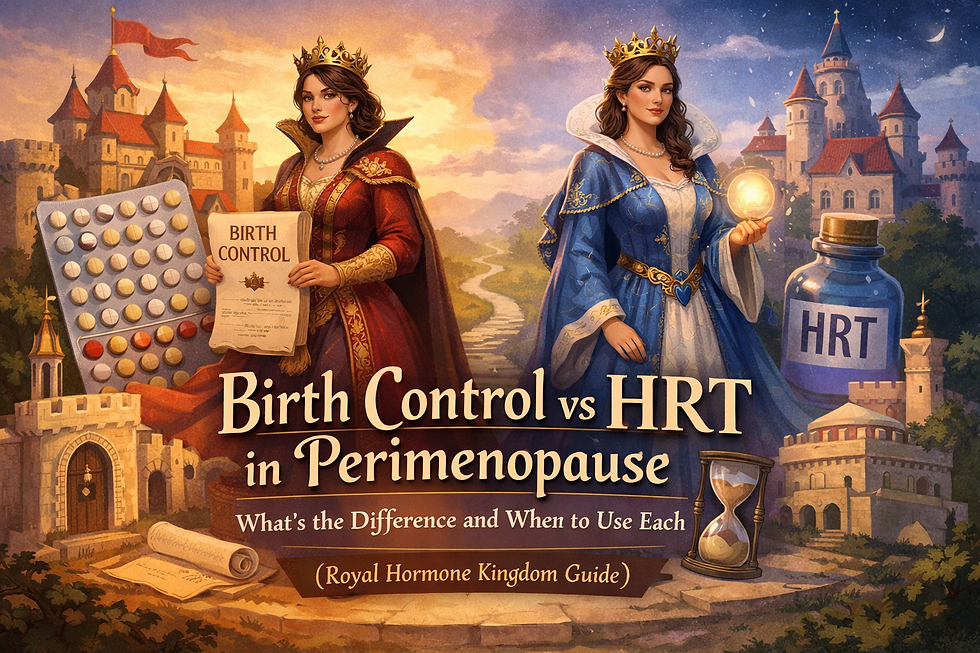
Somewhere between the late 30s and early 50s, the Royal Hormone Kingdom starts changing its rhythm.
The Queen no longer keeps a predictable schedule.The King shows up inconsistently.
And the royal court( your brain, sleep, metabolism, and mood ) starts noticing the disruption.
This phase is called Perimenopause.
And this is when many women are offered one of two options:
Birth control pills
Hormone replacement therapy (HRT)
Both involve hormones.Both can improve symptoms.
But they serve very different roles inside the body.
Understanding the difference between birth control vs HRT in perimenopause is what allows you to choose the right treatment at the right time.
What is the difference between HRT and Birth Control Pills
At a physiological level, these two treatments are designed for completely different purposes.
Birth Control: Suppression and Control
Birth control pills work by:
Suppressing ovulation
Flattening hormone fluctuations
Replacing your natural cycle with synthetic hormones
In the Royal Kingdom: They step in and temporarily take over leadership.
This can be helpful when hormones are still being produced but in an unpredictable, disruptive pattern.
Hormone Replacement Therapy (HRT): Restoration and Support
HRT works by:
Replacing declining estrogen levels
Supporting the body with more physiologic dosing
Allowing the natural system to continue functioning, just with reinforcement
In the Kingdom:The Queen is still present but losing influence.
HRT stabilizes the system without shutting it down.
When to use Birth Control in Perimenopause ?
Birth control pills are often appropriate earlier in perimenopause, when hormone production is still active but inconsistent.
You may benefit from birth control if you have:
Irregular but ongoing periods
Heavy or frequent bleeding
PMS-like symptoms or mood swings
Acne or hormonal skin changes
A need for pregnancy prevention
In this phase, estrogen levels are not consistently low, they are fluctuating.
Birth control can create stability by reducing those swings.
When to use HRT in Perimenopause and Menopause ?
As perimenopause progresses, hormone levels begin to decline more consistently.
This is when HRT becomes the more appropriate tool.
You may benefit from HRT if you have:
Hot flashes or night sweats
Sleep disruption
Vaginal dryness or discomfort
Brain fog or memory changes
Fatigue or reduced resilience
Longer gaps between periods or no periods
These symptoms are driven by low estrogen, not just fluctuation.
And this is where suppression is no longer helpful, replacement is.
Medical Guidelines and Recommendations
Clear guidance exists, but it is often not explained well.
Hormone Replacement Therapy (HRT)
Most effective treatment for vasomotor symptoms (hot flashes, night sweats)
Best initiated before age 60 or within 10 years of menopause
Transdermal estrogen (patch or gel) is associated with lower clot risk than oral forms
Progesterone is required if the uterus is present
Birth Control in Perimenopause
Can be used in healthy, non-smoking women (typically up to age 50–55 depending on risk factors)
Effective for cycle regulation and symptom control
Does not treat menopause, it manages symptoms temporarily.
Risks, Side effects and Safety Considerations
Birth Control Pills
Benefits:
Predictable bleeding
Reduced menstrual pain
Lower risk of ovarian and endometrial cancer
Risks:
Increased risk of blood clots (especially with oral estrogen)
Possible mood changes
Can mask the transition into menopause.
Hormone Replacement Therapy (HRT)
Benefits:
Most effective treatment for hot flashes and night sweats
Improves sleep and quality of life
Supports bone health and reduces fracture risk
Improves vaginal and urinary symptoms
Risks (depend on individual factors):
Timing of initiation matters
Route and formulation matter
Requires individualized assessment based on personal and family history
How to decide: Birth Control vs HRT in Menopause ?
The decision is not based on age alone.
It comes down to what your body is doing right now.
It depends on wether your symptoms are coming from hormone fluctuation… or hormone decline?
Fluctuation (erratic cycles, swings) → birth control may help
Decline (low estrogen symptoms) → HRT is often more appropriate
There is also a transition phase where women move from one to the other.
Recognizing that shift is key.
Final Word: Birth Control Pills Vs HRT in Perimenopause and Menopause
If the Queen is still ruling but erratic, you may need structure.
If she’s stepping down, you need support.
The problem is, many women in perimenopause are given the same solution for both: birth control pills.
And that’s where confusion around birth control vs HRT begins.
Because by midlife, the real question is no longer:“Do we control the hormones?”
It’s:“Are there enough hormones left to work with?”
Birth control pills can regulate cycles and reduce hormonal swings in perimenopause. They create predictable patterns and are often used as a short-term strategy for symptom control.
But when estrogen levels begin to decline as they do in late perimenopause and menopause, this approach can mask what’s actually happening.
Using birth control in this phase is like turning off lights in a room that’s already going dark.
It doesn’t address low estrogen, which is the driver behind symptoms like hot flashes, sleep disruption, and vaginal dryness.
This is where hormone replacement therapy (HRT) becomes the appropriate tool.
HRT is designed to replace declining hormones, not suppress them. When started at the right time, it is one of the most effective, evidence-based treatments for menopause symptoms and long-term health support.
So when deciding between birth control vs HRT in perimenopause, the key is understanding your phase:
Ongoing but irregular cycles → hormonal fluctuation → birth control may help
Declining or absent cycles → low hormone levels → HRT is often more appropriate
Good medicine is not about treating every woman the same way.
It’s about identifying whether the issue is hormone fluctuation or hormone deficiency and choosing the treatment that matches it.
Choosing the Right Hormone Strategy in Perimenopause and Menopause

If you’re in perimenopause or menopause and trying to decide between birth control and hormone therapy, this is where personalized care matters. I work with women to assess what their hormones are actually doing, not just treat symptoms in isolation.
Together, we look at your cycle patterns, symptoms, risk factors, and goals to determine whether your body needs regulation, support, or a transition in strategy.
Because the right treatment depends on your phase and getting that right changes everything. You can book a Telemedicine or a Womens Health Coaching Visit or Menopause coaching Visit to discuss further.
Let's Flourish and Bloom Together


Comments